
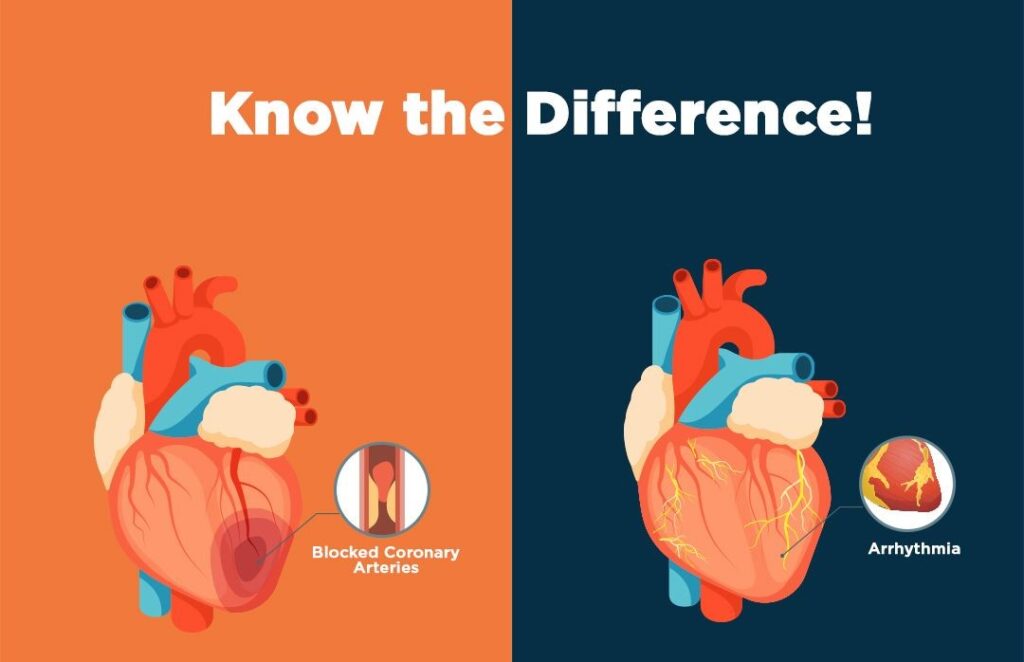
Heart Attack vs Cardiac Arrest: What’s the Difference?
Quick answer: A heart attack is a circulation problem — a blocked artery starves the heart muscle of blood. Cardiac arrest is an electrical problem — the heart stops beating entirely. Both are life-threatening emergencies, but they require different responses. Read on to understand the difference clearly.
7M+ Heart attacks occur globally every year
10% Survival rate for out-of-hospital cardiac arrest without CPR
3× Higher survival when CPR is started within 3 minutes
In this article
- What is a heart attack?
- What is cardiac arrest?
- Key differences at a glance
- Can a heart attack cause cardiac arrest?
- Warning signs of a heart attack
- What to do during a cardiac arrest
- Survival rates and why speed matters
- How to reduce your risk of both
- Frequently asked questions
What Is a Heart Attack?
A heart attack — medically called a myocardial infarction (MI) — occurs when a coronary artery becomes blocked, cutting off the blood supply to part of the heart muscle. Without blood (and the oxygen it carries), the affected muscle tissue begins to die.
The blockage is usually caused by a blood clot that forms when a fatty plaque inside the artery wall ruptures. This process — called atherosclerosis — develops silently over decades, which is why heart attacks so often seem to strike without warning.
Think of it this way: The heart is a pump, and the coronary arteries are its fuel lines. A heart attack is what happens when a fuel line gets blocked. The pump is still trying to work — but parts of it are being starved of fuel and beginning to fail.
Key characteristics of a heart attack:
- The heart usually continues to beat (though weakly or irregularly)
- The person is typically conscious and aware
- Symptoms often develop over minutes to hours
- It is a circulation problem — blocked blood flow to the heart muscle
- Immediate treatment: restore blood flow via clot-dissolving drugs or emergency angioplasty
What Is Cardiac Arrest?
Cardiac arrest occurs when the heart’s electrical system malfunctions so severely that the heart stops pumping blood altogether. The heart either beats in a chaotic, ineffective rhythm (ventricular fibrillation) or stops beating entirely (asystole).
When the heart stops, blood flow to the brain ceases within seconds. Loss of consciousness occurs within 10–20 seconds. Without immediate intervention, brain death begins within 4–6 minutes.
Think of it this way: If a heart attack is a blocked fuel line, cardiac arrest is the engine completely shutting off. The person collapses, is unresponsive, and has no pulse. Without CPR and defibrillation, death follows within minutes.
Key characteristics of cardiac arrest:
- The heart stops pumping blood effectively
- The person collapses and is unconscious — no response to touch or voice
- There is no normal breathing
- No pulse can be detected
- It is an electrical problem — the heart’s rhythm breaks down
- Immediate treatment: CPR and defibrillation with an AED
Key Differences at a Glance
Heart Attack
- Cause: Blocked coronary artery
- Type: Circulation problem
- Consciousness: Usually awake and aware
- Heart beating? Yes — but struggling
- Onset: Gradual (minutes to hours)
- Symptoms: Chest pain, breathlessness, sweating
- First response: Call 999/112, give aspirin
- Treatment: Angioplasty or clot-busting drugs
Cardiac Arrest
- Cause: Electrical failure of the heart
- Type: Electrical problem
- Consciousness: Unconscious, unresponsive
- Heart beating? No — or chaotically
- Onset: Sudden, without warning
- Symptoms: Sudden collapse, no pulse, no breathing
- First response: Start CPR immediately, use AED
- Treatment: Defibrillation, advanced cardiac life support
| Feature | Heart Attack | Cardiac Arrest |
| Medical term | Myocardial infarction (MI) | Sudden cardiac arrest (SCA) |
| Root cause | Blocked coronary artery | Lethal heart rhythm disturbance |
| Heart still beating? | Yes | No (or ineffectively) |
| Conscious? | Usually yes | No — sudden collapse |
| Has a pulse? | Yes | No |
| Breathing? | Yes (may be laboured) | No normal breathing |
| Warning symptoms? | Often yes — chest pain, breathlessness | Usually none — sudden onset |
| Immediate action | Call emergency services urgently | CPR + AED immediately |
| Hospital treatment | Angioplasty or thrombolysis | Defibrillation, ICU care |
| Survival without treatment | Depends on extent of blockage | Near zero after 10 minutes |
Can a Heart Attack Cause Cardiac Arrest?
Yes — and this is one of the most important connections between the two conditions. A heart attack can trigger cardiac arrest.
When the heart muscle is deprived of oxygen during a heart attack, the affected area can become electrically unstable. This instability may trigger ventricular fibrillation — a chaotic, fast electrical rhythm that prevents the heart from pumping blood effectively. When ventricular fibrillation occurs, the heart attack has progressed to cardiac arrest.
This is why heart attack patients require continuous cardiac monitoring in hospital. The period immediately following a heart attack is the highest-risk time for a fatal arrhythmia — and why early treatment of the heart attack is so critical.
Important distinction: Not all cardiac arrests are caused by heart attacks. Cardiac arrest can also be triggered by severe electrolyte imbalances, drug overdose, severe hypothermia, trauma, drowning, or inherited arrhythmia syndromes such as Long QT syndrome and Brugada syndrome — even in young people with no structural heart disease.
Warning Signs of a Heart Attack
Recognising a heart attack early — before it can progress to cardiac arrest — can save a life. The classic symptoms include:
Classic symptoms (more common in men):
- Chest pain or pressure — often described as a tight, heavy, squeezing, or crushing sensation in the centre or left of the chest
- Pain radiating to the left arm, both arms, jaw, neck, or upper back
- Shortness of breath — at rest or with minimal exertion
- Cold sweats — sudden sweating without heat or exertion
- Nausea or vomiting
- Dizziness or lightheadedness
Atypical symptoms (more common in women):
- Unusual or extreme fatigue — sometimes days before the event
- Jaw, neck, or upper back pain without chest discomfort
- Nausea or indigestion-like discomfort
- Shortness of breath without significant chest pain
For women: Heart attack symptoms in women are more likely to be subtle and atypical — which is a major reason heart attacks in women are more frequently missed or misdiagnosed. If you are a woman experiencing unusual fatigue, jaw pain, or persistent nausea alongside any of the above, seek medical evaluation promptly. Trust your instincts.
Call emergency services (112 / 108 in India) immediately if you experience:
- Chest pain or pressure lasting more than 5 minutes
- Chest pain accompanied by sweating, nausea, or arm pain
- Sudden severe breathlessness at rest
- Any combination of the above symptoms, even if mild
- Someone collapsing and becoming unresponsive — start CPR immediately
What to Do During a Cardiac Arrest: CPR and AED
When someone collapses and is unresponsive, every second counts. Cardiac arrest survival rates drop by 7–10% for every minute without CPR. Here is what to do:
- Check for response. Tap the person’s shoulders firmly and shout “Are you okay?” Check for normal breathing for no more than 10 seconds. Occasional gasping (agonal breathing) is not normal breathing.
- Call for help immediately. Call 112 (India) or your local emergency number. If others are present, point to a specific person: “You — call 112 now.” Tell another person to find the nearest AED.
- Start chest compressions. Place the heel of your hand on the centre of the chest (lower half of the breastbone). Place your other hand on top and interlock fingers. Push down hard and fast — at least 5–6 cm deep, at a rate of 100–120 compressions per minute. Allow the chest to fully recoil between compressions.
- Give rescue breaths (if trained). After 30 compressions, tilt the head back, lift the chin, and give 2 rescue breaths of 1 second each. If you are not trained or unwilling, continue hands-only CPR — it is still highly effective.
- Use the AED as soon as it arrives. Automated External Defibrillators (AEDs) are designed for untrained bystanders — turn it on and follow the voice instructions exactly. Apply the pads to bare skin as shown. Do not hesitate to use it.
- Continue until help arrives. Do not stop CPR until emergency services arrive and take over, the person shows signs of life, an AED advises you to, or you are physically unable to continue.
Hands-only CPR works: If you are not trained in rescue breathing, hands-only CPR — continuous chest compressions at 100–120 per minute — is highly effective in the first few minutes of cardiac arrest and is strongly recommended over doing nothing. The Bee Gees song “Stayin’ Alive” is exactly 100 BPM — use it as your mental metronome.
Survival Rates: Why Speed Is Everything
The contrast in survival outcomes between heart attacks and cardiac arrest — and between treated and untreated cardiac arrest — is dramatic:
| Scenario | Approximate Survival Rate |
| Heart attack treated within 90 minutes (primary PCI) | Over 95% in-hospital survival |
| Heart attack with delayed treatment (over 6 hours) | Significantly lower; depends on extent of damage |
| Cardiac arrest — CPR started within 1 minute | Up to 70–90% survival (with defibrillation) |
| Cardiac arrest — CPR started after 10 minutes | Below 5% survival |
| Out-of-hospital cardiac arrest without bystander CPR | Approximately 5–8% overall |
| Cardiac arrest in hospital with immediate treatment | Approximately 20–25% |
These numbers make one thing absolutely clear: in both conditions, the speed of response determines survival more than almost any other factor. Calling for help immediately and starting CPR without hesitation are the two most important things a bystander can do.
How to Reduce Your Risk of Both
The good news is that many of the lifestyle changes that reduce heart attack risk also reduce the risk of cardiac arrest — since the most common trigger for cardiac arrest is an underlying heart condition.
Evidence-based prevention strategies:
- Know and manage your cardiovascular risk factors — blood pressure, cholesterol, blood sugar, and body weight
- Exercise regularly — at least 150 minutes of moderate aerobic activity per week
- Follow a heart-healthy diet — rich in vegetables, whole grains, legumes, and healthy fats; low in salt, sugar, and processed foods
- Quit smoking — smoking is one of the strongest risk factors for both heart attack and sudden cardiac arrest
- Treat sleep apnoea — untreated sleep apnoea significantly increases the risk of arrhythmias and cardiac arrest
- Manage stress — chronic stress elevates blood pressure and promotes the cardiac inflammation that drives atherosclerosis
- Get regular cardiac screening — particularly if you have a family history of sudden cardiac death or early heart disease
- Take prescribed medications consistently — statins, antihypertensives, and antiplatelet therapy all reduce heart attack and cardiac arrest risk
- Learn CPR — you cannot prevent every cardiac arrest, but being able to respond effectively when one happens could save someone’s life
For inherited arrhythmia syndromes: If you have a family history of sudden unexplained death in a young relative (under 40), unexplained syncope (fainting), or have been told you have a heart rhythm problem, ask your cardiologist about genetic testing and screening for inherited arrhythmia syndromes. These conditions — including Long QT syndrome, Brugada syndrome, and hypertrophic cardiomyopathy — can cause sudden cardiac arrest in otherwise healthy young people and are detectable with proper evaluation.
Frequently Asked Questions
Is cardiac arrest always fatal?
Can you have a cardiac arrest without a heart attack?
What is the difference between CPR and defibrillation?
Should I give aspirin during a heart attack?
How can I learn CPR in India?
Concerned About Your Cardiac Risk?
A cardiac risk evaluation can identify your personal risk of heart attack and sudden cardiac arrest — and give you a clear action plan. Early detection saves lives.